Dusty’s Wrongful Conviction
Originally from Indiana, Dusty was convicted in 1996 for murder and abduction with intent to defile. Despite overwhelming evidence that his Navy SEAL 'swim buddy' Billy Joe Brown, who later confessed to acting alone, was the real perpetrator, Dusty received an 82 years sentence. Brown, also convicted of attempted rape, was sentenced to 72 years.
During a night out in 1995, Brown killed the victim in a sudden fit of rage in the parking lot of the Bayou nightclub in Virginia Beach. Despite Dusty's attempts to stop him and free the victim, he could not save her. In a moment of panic and bound by misplaced loyalty to the SEAL Code to never abandon your 'swim buddy' instilled upon him through his Navy SEAL training, Dusty helped cover up the crime for several days before reporting the truth to his commanding officer and authorities. As a result, Dusty became an accessory after the fact punishable by a max. of 12 months at the time which he had already served when his trial started. Instead he was incarcerated for 31 years for crimes he did not commit.
A Case Based On The False Statements of The Perpetrator
The case against Dusty rested entirely on the false statements of the real perpetrator, Billy Joe Brown. After violating the Navy SEAL code by speaking to authorities, Billy falsely accused Dusty of the victim's murder. Over several days of interrogation, Billy gave multiple contradictory and demonstrably false accounts of the events. Even though polygraph results indicated that Billy killed the victim, authorities chose to pursue a version of events that implicated both men.
The Polygraph and How Dusty was Framed
The Investigation and Exculpatory Evidence (Part I)
Despite overwhelming evidence that Billy Joe Brown’s statements were contradictory and demonstrably false, authorities in 1995 relied on them to build a case against Dusty that enabled the conviction of two people rather than one. The polygraph results, which implicated Billy, were never entered into evidence and thus could not be used in Dusty’s defense. Forensic analysis found no evidence of a struggle, violence, or sexual activity inside the vehicle.
The Investigation And Exculpatory Evidence (Part II)
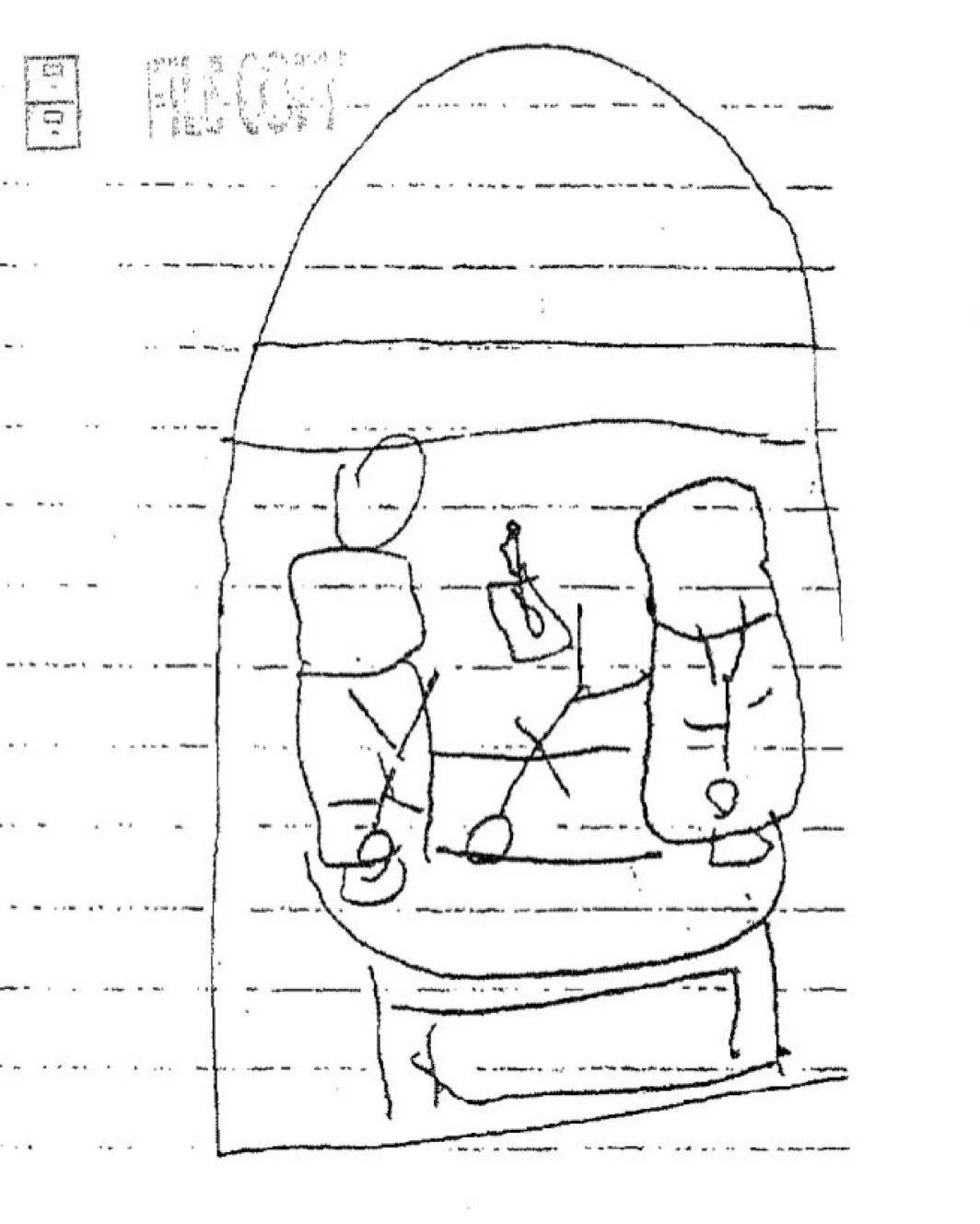
Crucial forensic evidence from the front seat- which would have confirmed the victim’s presence there rather than in the back seat as Billy claimed -was never processed and was later destroyed. Further analysis of hair and fiber from the rear of the car was halted, and no technical examination of the vehicle was conducted. Such analysis would have shown that:
(i) The seats in Dusty’s Geo Storm did not fold backward, contrary to Billy’s claims
(ii) A central console made the positioning Billy described physically impossible
(iii) The vehicle’s interior dimensions could not accommodate Billy’s account At trial, the jury was not shown Dusty’s actual car, which sat outside the courtroom.
Instead, they were presented with a mock-up, preventing an accurate assessment of the vehicle’s true layout and dimensions .Taken together, this evidence corroborated Dusty’s account from the outset, yet it was systematically ignored.
The false drawing of the car by Billy Joe Brown
The Theory Of Abduction At Trial
At Dusty’s September 1996 trial, the prosecution argued that Jennifer Evans was forcibly abducted from the Bayou Club in Virginia Beach with the intent to defile and was later killed elsewhere. Under Virginia Code § 18.2-32, without a finding that Dusty acted in concert with Billy Joe Brown to commit abduction with intent to defile, he could not be convicted of felony murder. The evidence did not support this theory. Dusty showed his ID to Jennifer’s friends and arranged transportation for Brown to go home, who initially stayed behind at the club and only changed plans at the last minute after growing impatient while waiting for a ride. Billy’s later recantation further undermined—and ultimately contradicted—the prosecution’s theory.
Ineffective Counsel
Dusty did not have effective counsel at trial. Despite the media frenzy surrounding his case, no change of venue was requested and the media was allowed in court. The jury selection was not contested and the fastest the prosecution had ever seen. Only one expert witness was called by the defense and key character witnesses were not called. The trial only took two days with the defense resting its case one day before the scheduled end date.
A Fair Trial?
Despite the absence of any evidence that the victim was abducted from the parking lot of the Bayou Club, the trial court denied the defense motion to strike the abduction charge. When the jury sought clarification on the jury instructions, the presiding judge refused to answer their questions. At the sentencing phase, the court permitted the prosecution to urge the jury to impose a sentence intended to serve as a deterrent to others in the community. When the jury later submitted questions regarding parole eligibility and available sentencing options, the presiding judge declined to provide clarification. This refusal influenced and prejudiced the jury's sentencing determination.
Billy Brown's Recantation and The Writ of Actual Innocence
Despite Billy already confiding in others as early as 1996, that he killed the victim and that Dusty had no involvement, it was not until much later that the truth would officially be acknowledged. In 2008, during an evidentiary hearing for Dusty's petition for a Writ of Actual Innocence, Billy Brown confessed to falsely testifying at his own trial and to acting alone. A Circuit Court ruled that Dusty had NO ROLE IN THE MURDER OR RESTRAINT of the victim. In 2009, the Court of Appeals granted Dusty a Writ of Actual Innocence - the first in Virginia based on non-biological evidence. They held that 'no rational trier of fact could have found proof of guilt [ of felony murder and abduction with intent to defile] beyond a reasonable doubt" and vacated Dusty's convictions for these crimes.
The Theory of Abduction By Deception on Appeal
The 2009 grant of a Writ of Actual Innocence should have resulted in Dusty’s release. Instead, the Attorney General appealed two days later, and in 2010 the Court of Appeals sitting en banc overturned the writ. The Court reasoned that abduction did not require proof of restraint, despite the accepted legal definition of abduction as a restraint on personal liberty. Although Billy Brown’s recantation dismantled the prosecution’s original theory of forcible abduction from the Bayou Club parking lot, the Court nevertheless held that a rational trier of fact could have found Dusty guilty under a new theory-abduction by deception, allegedly by luring the victim to the parking lot. This theory was unsupported by the evidence, was never presented to the jury at trial and mirrored the dissenting opinion to the writ decision. The dissent to the en banc decision details why this theory was incorrect. In 2011, sadly the Virginia Supreme Court upheld the decision to overturn the writ.
The Essential Elements of The Crime That Were Not Proven
The appellate decisions mischaracterized witness testimony and omitted exculpatory statements. In addition, Virginia case law— in particular Johnson v. Commonwealth (1976) and Burton v. Commonwealth (2011)—makes it clear that abduction by deception alone is insufficient; under Va. Code § 18.2-47, the Commonwealth must also prove an intent to deprive the victim of liberty.
Could vs. Would
Under the Writ of Actual Innocence statute, the governing standard was whether a rational trier of fact could find guilt beyond a reasonable doubt—not merely whether any trier of fact would do so. Dusty met this extraordinary burden when the writ was granted by establishing that no rational factfinder could convict him. The facts, evidence, and controlling case law support that determination and show it should not have been overturned. The statute has since been amended to require a finding that a rational trier of fact would have found guilt beyond a reasonable doubt—an explicit legislative correction replacing the former, nearly impossible “could” standard with a fairer and more reasonable one. See In re Watford III (2018). Justice should not hinge on a single word, particularly where the truth has been clear from the outset. Dusty was never guilty of the crimes for which he has spent 31 years in prison.
Dusty’s Release on Parole
Dusty became eligible for parole in 2020 due to a legislative change affecting a narrow class of inmates whose juries were not informed that parole was unavailable at the time of sentencing. In October 2025, Dusty received the required majority votes from the parole board members to be released on parole. It took until January 7, 2026, for a public hearing to be scheduled to certify the votes following extensive advocacy and public pressure that had to be applied. At the public hearing, three of the five board members voted to grant parole. Mr. Carl Philips-Fergusson, a former prosecutor of more than 47 years stated that:
“What I do not believe is that before this murder occurred, you yourself in any way had any agreement with Billy Brown that you were going to do this and abduct her and take her
somewhere and do what occurred to her. I believe it was absolutely the truth and what Billy Brown said. And for that reason, I believe you have not only served the amount of time you
should serve. I believe you served far more time than you should have served. And for that reason, I am voting to grant you parole. “(Transcription based on video of the public hearing.)
Parole is not freedom for Dusty. After originally having only had 5 conditions imposed by the Virginia Parole Board, upon release he was forced to sign a list with over 30 conditions. Various conditions appear overly broad, overly restrictive, and insufficiently tailored to any demonstrated supervision need given his low-risk status.
Support for Dusty in His Fight For Justice
In his fight for justice, Dusty has the support of a broad coalition, including criminal justice advocates, veterans, trial jurors, members of the late deputy prosecutor’s family, the Navy investigator assigned to his case, and the psychologist who evaluated him in prison. More than 18,000 people from across the United States and around the world have signed a petition calling for his release and for justice . Over three decades of wrongful imprisonment, Dusty has been a model prisoner, mentoring others, initiating and leading various programs, and guiding youth and veterans. His has no prior or institutional record of violence.
Dusty’s release on parole is a first step towards justice.
The Fight For Dusty's Full Exoneration continues.
No Signs of Struggle in the Car & No Technical Analysis of the Car
“Selling the Jury” the prosecution’s theory at trial